FADDY AL-HASAN
2024
Newcross Healthcare Solutions
Flexible healthcare staffing with reliable match matching.
User Experience (UX)
Digital Strategy
Data Analysis
User Interface (UI)
Design Systems
User Research
Interaction Design
Client /
Newcross Healthcare Solutions
Leading design across a healthcare staffing platform connecting 165,000 carers with 2000+ clients across care homes, children’s services, and the justice sector. Supporting rapid, reliable shift matching, including HealthForceGo, HealthForceConnect, internal operational tools, and a new NeutralVend workforce platform.
Working closely with product managers, engineers, and stakeholders to shape product strategy, improve complex operational workflows, and deliver scalable user-centered experiences across both mobile and web.


Newcross Healthcare Solutions
🤖
MVP Transformation
Reduced booking response times by 35% and support calls by 11%
🎨
Design
System
Reduced booking response times by 35% and support calls by 11%
🚙
Journey Simplification
Reduced booking response times by 35% and support calls by 11%
✨
AI
Foundations
Reduced booking response times by 35% and support calls by 11%


Rethinking Coverage: What the Data Was Actually Telling Us
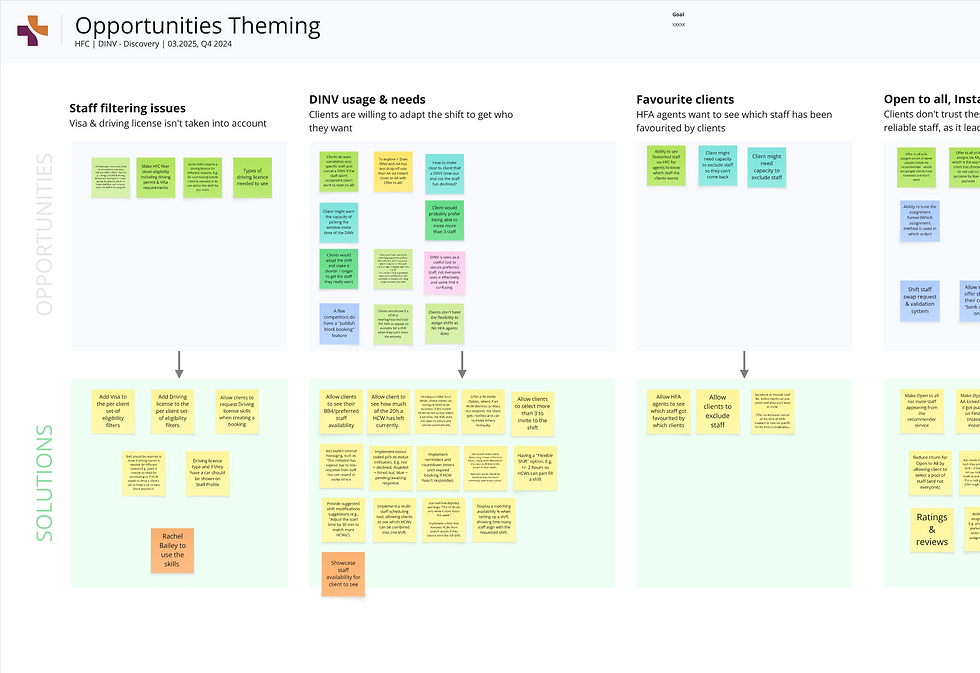
PowerBI data initially suggested a growing number of shifts were going uncovered. Working closely with the Data team, we dug deeper into the quantitative data, reviewed customer support calls, and interviewed clients to understand the underlying causes behind the trend.
Through this research, we uncovered that a significant portion of the “uncovered” shifts were actually duplicate bookings created because clients had no effective way to amend existing shifts. The work also revealed broader themes around operational flexibility and staff quality concerns, which went on to shape several roadmap priorities for the rest of the year.
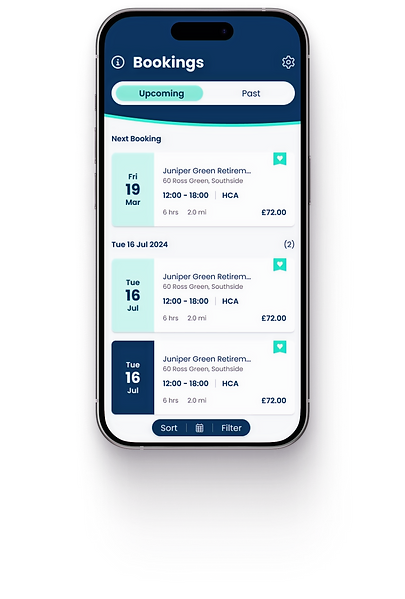
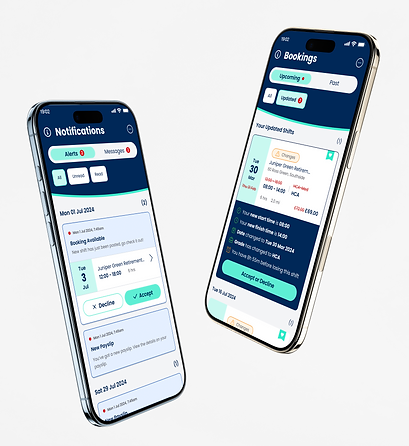
Following the release of the new editing experience and a focused period of hypercare, the updated journey achieved a 93% acceptance rate within 17 minutes during the first month, alongside an 11% reduction in calls to the contact centre.
AI-Enabled Design System
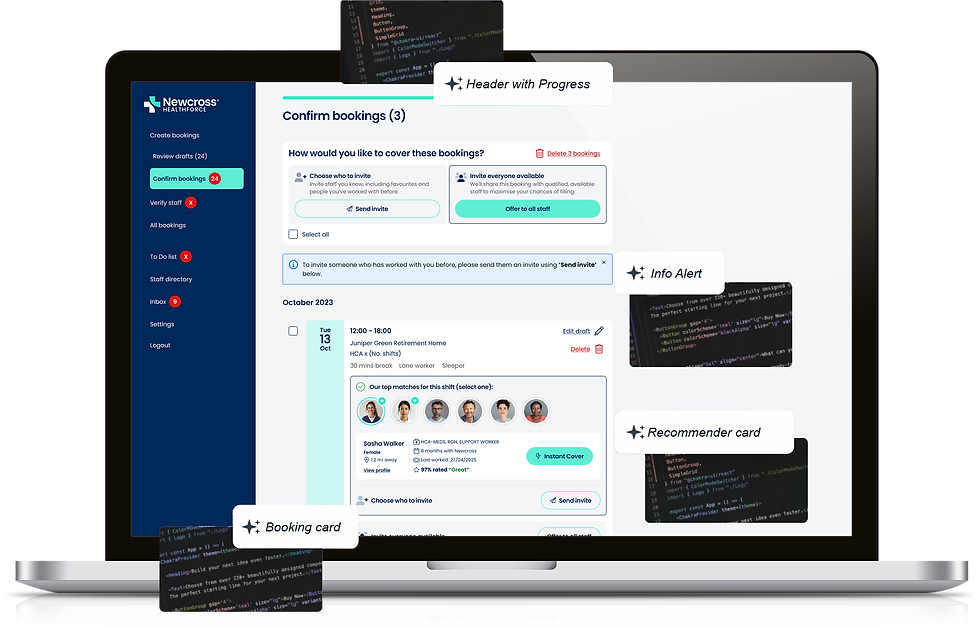
We redesigned and rebuilt our Halo design system, for all our HealthForce products, to be AI-friendly from the ground up, creating a structured, reusable system that could integrate directly with Claude.
By aligning components, naming conventions, patterns, and documentation into a consistent framework, we enabled AI-generated concepts and screens to pull directly from the live design system rather than generating disconnected UI.
This allowed us to rapidly explore ideas, prototype flows, and generate production-aligned interface concepts significantly faster, while still maintaining consistency across products and platforms.
The approach helped reduce repetitive design work, accelerated early-stage ideation, and created a more scalable workflow between design, product, and engineering teams.
Building Trust in Auto-Assign
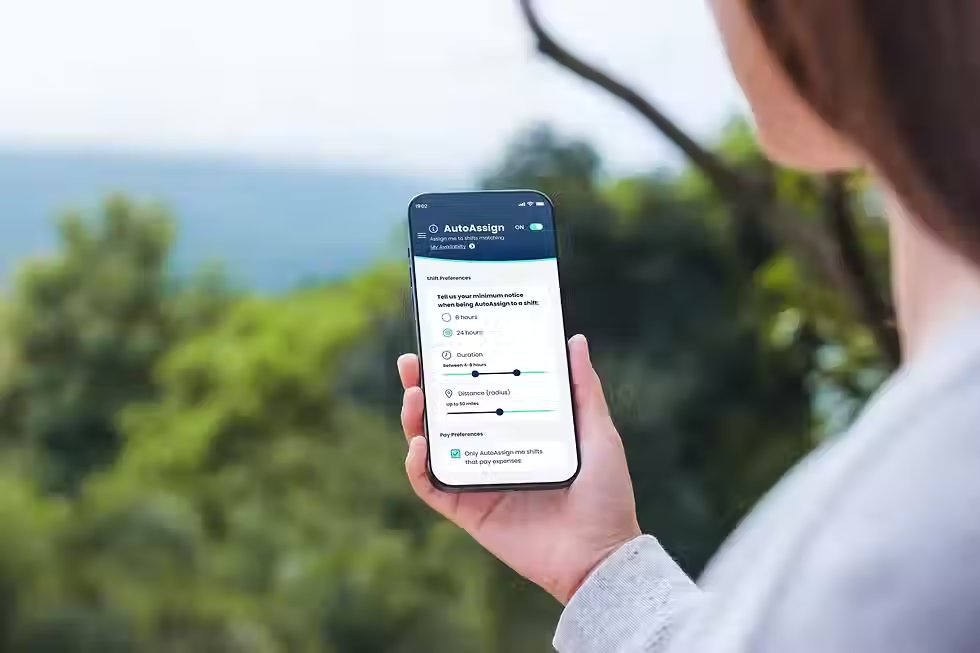
While our machine learning-driven recommender system made Auto-Assign highly effective, discovery research and usability testing revealed a major trust and perception problem among users.
Many staff felt they were “competing against the system” or losing control over how shifts were offered and accepted, despite the feature being designed to improve speed and fairness.
Through research, we uncovered widespread misunderstanding around how Auto-Assign actually worked, which led to both product improvements and a revised go-to-market communication strategy focused on transparency, control, and clarity.
Following the changes, app store ratings increased from 3.3 to 4.0, alongside a 41% increase in Auto-Assign adoption.
The redesigned Direct Invitation experience drove significant adoption and operational improvements across the platform. Direct invitations sent increased by 94% week-over-week, reaching 132% above the previous all-time high, while successful direct-invite bookings grew by 62%.
The release also improved efficiency, with time-to-accept reducing by 35% and overall booking coverage increasing by 6%, reinforcing Direct Invitation as the platform’s most reliable assignment method.
However, the release also revealed important marketplace and workflow trade-offs. While coverage improved, total booking hours created fell by 5.7%, potentially linked to added friction within booking creation and limitations around block booking workflows.
We also observed a 50% spike in booking draft deletions immediately after launch, suggesting clients were attempting and struggling to recreate previous workflows within the new experience. Longer-term analysis highlighted broader ecosystem risks. As “Offer to All” usage declined, more shifts were concentrated among highly engaged or previously-rated staff, reducing visibility of opportunities for the wider workforce.
This correlated with increased staff churn and lower engagement within Find Shift, highlighting the importance of balancing operational efficiency with marketplace accessibility and long-term supply sustainability in a two-sided staffing platform.
Scaling Direct Invitations While Managing Marketplace Risk
Scaling care through design
Key outcomes include:
+94% increase in Direct Invitations sent
+62% increase in successful Direct Invitation bookings
-35% reduction in time-to-accept
+6% increase in booking coverage
-30% reduction in cancellations reverting to “Offer to All”
My Role
As Principal Product Designer, I led discovery, UX strategy, and end-to-end design across HFGo and HFC. Working closely with product managers, engineers, operational teams, and stakeholders, I translated complex healthcare staffing challenges into scalable digital solutions.
My responsibilities included user research, service design, interaction design, design system development, experimentation, and measuring product success through data and user feedback. I also helped establish research practices and championed accessibility and user-centered design across the organisation.
As Principal Product Designer, I led discovery, UX strategy, and end-to-end design across HFGo and HFC. Working closely with product managers, engineers, operational teams, and stakeholders, I translated complex healthcare staffing challenges into scalable digital solutions.
My responsibilities included user research, service design, interaction design, design system development, experimentation, and measuring product success through data and user feedback. I also helped establish research practices and championed accessibility and user-centered design across the organisation.

Outcomes & Impact
Across HFGo and HFC, I helped improve the experience for both healthcare workers and clients through research-led design and continuous product optimisation.
Key outcomes included:
Direct Invitations increased by 94% week-over-week.
Successful Direct Invitation bookings increased by 62%.
AutoAssign adoption increased by 41%.
Reduced operational support requests through improved booking workflows.
Contributed to improving HFGo app ratings from 3.3 to 4.0.
Established scalable research and design practices across product teams.
These improvements helped drive greater staffing efficiency, continuity of care, and user satisfaction at scale.
Across HFGo and HFC, I helped improve the experience for both healthcare workers and clients through research-led design and continuous product optimisation.
Key outcomes included:
Direct Invitations increased by 94% week-over-week.
Successful Direct Invitation bookings increased by 62%.
AutoAssign adoption increased by 41%.
Reduced operational support requests through improved booking workflows.
Contributed to improving HFGo app ratings from 3.3 to 4.0.
Established scalable research and design practices across product teams.
These improvements helped drive greater staffing efficiency, continuity of care, and user satisfaction at scale.
Final Reflection
This work reinforced that successful products are built as much on trust and clarity as they are on functionality. Many of the biggest gains came from simplifying complex workflows, improving communication, and helping users make confident decisions.
Looking ahead, I see the greatest opportunities in AI-assisted staffing, deeper personalisation, and creating a more unified booking experience that balances flexibility with simplicity.
The experience strengthened my ability to lead product strategy, align cross-functional teams, and deliver measurable outcomes in a complex healthcare environment.