FADDY AL-HASAN
2025
Opserra
Rescuing an AI-Built Product from AI-Driven Product Decisions 🤖
User Experience (UX)
Digital Strategy
Data Analysis
User Interface (UI)
Design Systems
User Research
Interaction Design
Client /
Opserra
Opserra is a workforce and staffing platform designed to help organisations manage bookings, staffing suppliers, workforce compliance and fulfilment at scale.


Opserra
🤖
MVP Transformation
Reduced booking response times by 35% and support calls by 11%
🎨
Design
System
Reduced booking response times by 35% and support calls by 11%
🚙
Journey Simplification
Reduced booking response times by 35% and support calls by 11%
✨
AI
Foundations
Reduced booking response times by 35% and support calls by 11%


Overview
The product was being built in a highly AI-enabled environment, where engineers and stakeholders were using AI to rapidly generate platform features, workflows and interface patterns.
The ambition was strong: move quickly, reduce build time, and use AI to accelerate both product design and development. But the reality was more complicated.
Without enough research, product definition or design foundations, the team had started building faster than they were learning. AI enabled rapid output, but it also created a product that was becoming bloated, inconsistent and difficult to use.
My role was to bring product design discipline into the process, establish scalable foundations, and turn a fragmented AI-built platform into a coherent MVP.
The Challenge
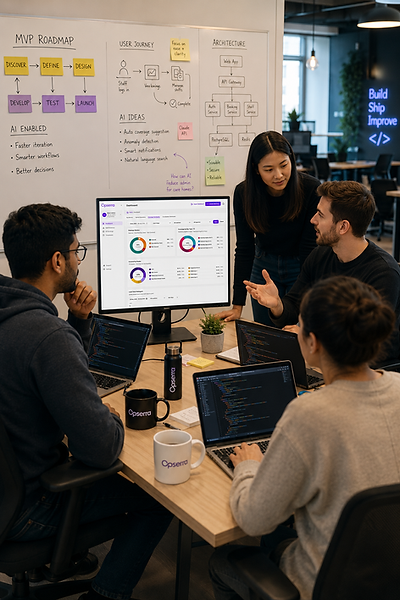
AI enabled the team to build quickly, but without research, design foundations or validated user needs, the platform became increasingly complex.
Features were often generated based on stakeholder assumptions rather than user evidence. Multiple workflows solved similar problems, interactions were inconsistent, and functionality expanded faster than it could be validated.
The result was a product that appeared feature-rich but lacked clarity, consistency and usability.
The challenge was not to redesign individual screens, it was to create a coherent product from an expanding collection of AI-generated functionality.

Why AI alone was not enough
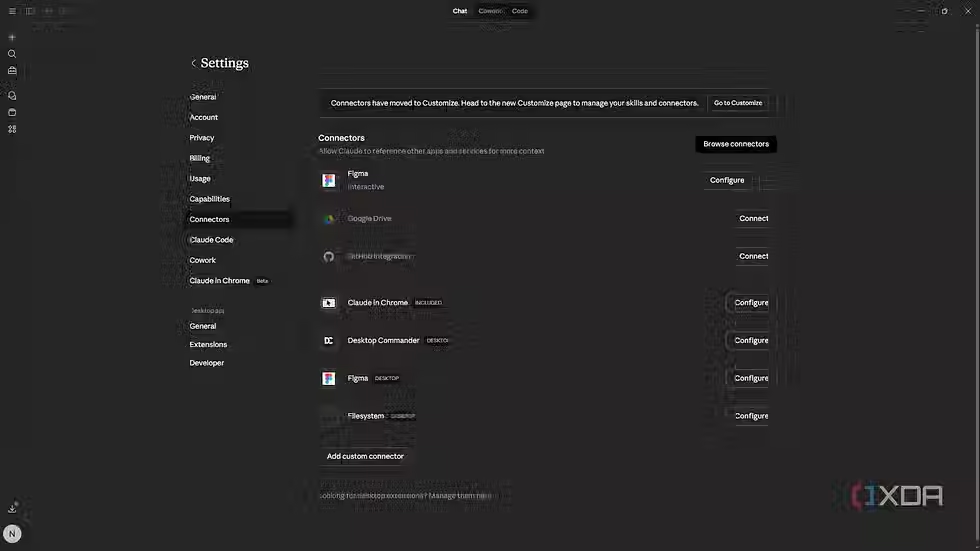
One of the most important lessons from the project was understanding where AI adds value and where it falls short.
AI was extremely effective at producing interfaces and code, but it frequently generated solutions before the problem had been fully understood.
This led to:
Bloated feature sets
Duplicate workflows
Inconsistent patterns
Hallucinated business logic
Poor information architecture
Features with unclear user value
The platform had effectively skipped discovery and moved straight into delivery.
What was missing wasn't better AI.
It was product strategy.
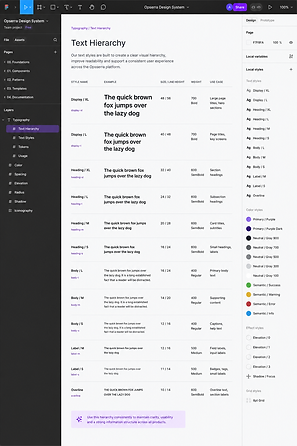
Before redesigning features, I focused on creating the foundations needed for a scalable product.
A Tailwind CSS design system was introduced to provide consistency across both design and AI-generated development.
The system defined:
Colour tokens and semantic usage
Typography hierarchy
Spacing and layout principles
Navigation patterns
Forms and tables
Component variants
Status and feedback states
Accessibility standards
Because AI development relies heavily on structure and predictability, creating these foundations dramatically improved implementation quality and reduced design drift.
Establishing Foundations
Rebuilding core journeys
Once foundations were in place, I audited the platform's primary workflows and redesigned them from the ground up.
Each journey was assessed against:
User value
Business value
Frequency of use
Complexity
Operational impact
The focus shifted from asking:
"What can we build?" to: "What problem are we solving?"
This helped simplify the experience, reduce duplication and define a clearer MVP scope.
Feature Design & MVP Definition
Several major platform capabilities were redesigned and refined as part of the MVP.
Block Bookings
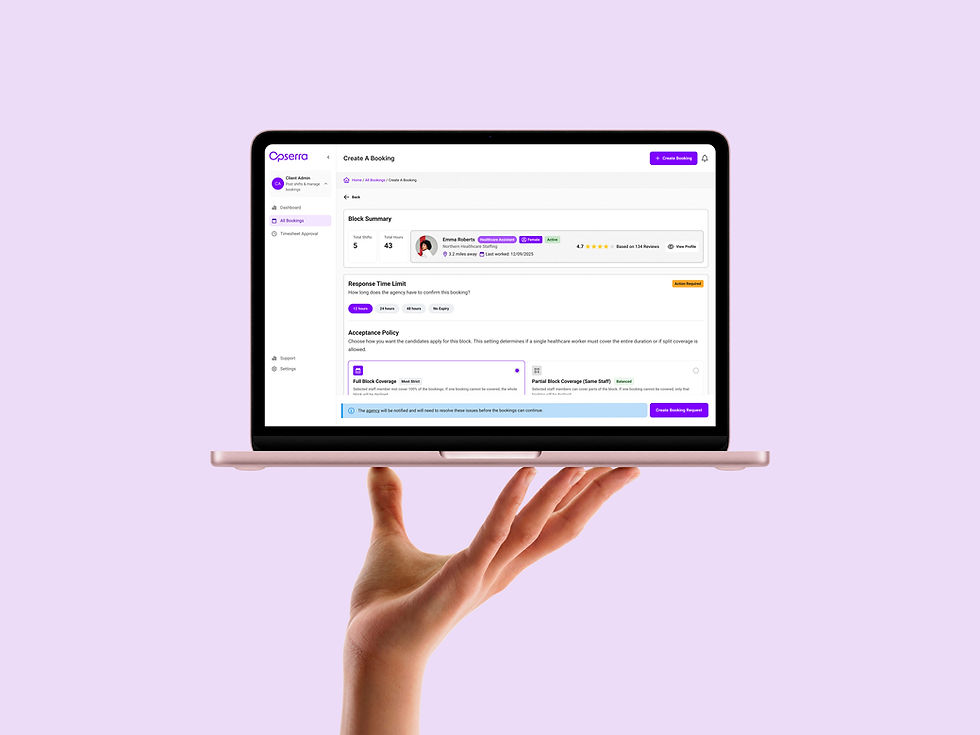
Designed a workflow allowing clients to create and manage multiple related bookings while maintaining continuity of care, compliance checks and agency workflows. The experience supports eligibility validation, Working Time Directive rules and flexible acceptance scenarios.
Agency Priority Rules
Designed a supplier management experience allowing organisations to structure agency relationships through configurable priority tiers, access windows and booking cascades. This gave clients greater control over fulfilment while improving transparency across suppliers.
Each feature was designed as an MVP first, focusing on solving a specific operational problem before introducing additional complexity.
Several major platform capabilities were redesigned and refined as part of the MVP.
Block Bookings
Designed a workflow allowing clients to create and manage multiple related bookings while maintaining continuity of care, compliance checks and agency workflows. The experience supports eligibility validation, Working Time Directive rules and flexible acceptance scenarios.
Agency Priority Rules
Designed a supplier management experience allowing organisations to structure agency relationships through configurable priority tiers, access windows and booking cascades. This gave clients greater control over fulfilment while improving transparency across suppliers.
Each feature was designed as an MVP first, focusing on solving a specific operational problem before introducing additional complexity.
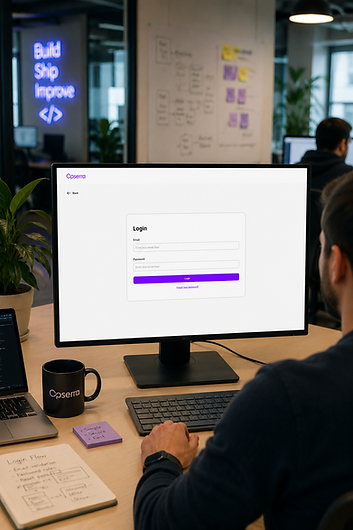

The Reality of Designing Without Users
One of the biggest constraints was the lack of direct access to end users. Most requirements originated from:
Internal stakeholders
Operational teams
Business assumptions
Existing processes
While this allowed rapid decision-making, it also introduced risk. Many solutions were based on what users were expected to need rather than validated behaviours.
As a result, every feature was intentionally treated as a hypothesis rather than a final solution. The goal was to launch, learn and iterate rather than assume correctness.
One of the biggest constraints was the lack of direct access to end users. Most requirements originated from:
Internal stakeholders
Operational teams
Business assumptions
Existing processes
While this allowed rapid decision-making, it also introduced risk. Many solutions were based on what users were expected to need rather than validated behaviours.
As a result, every feature was intentionally treated as a hypothesis rather than a final solution. The goal was to launch, learn and iterate rather than assume correctness.
Reflection and Outcome
Opserra demonstrated both the power and limitations of AI-driven product development. AI significantly accelerated delivery, implementation and experimentation. However, it also amplified the consequences of weak product decisions.
The project reinforced that successful products are not created by building faster.
They are created by understanding users, validating assumptions and solving meaningful problems.
Key outcomes included:
Establishing a scalable design system
Creating consistency across the platform
Reducing AI-generated design drift
Defining a clear MVP scope
Improving collaboration between design and engineering
Creating a framework for future user-led iteration
Today, the platform is entering a new phase where real customer feedback is beginning to replace assumptions, allowing the team to evolve the product based on evidence rather than intuition.
The biggest lesson was simple:
AI can accelerate delivery, but it cannot replace product thinking.